

MD&A · 2025
In this section4 topics
Overview of Operations
Section Introduction
The Company operates on three core lines of business, namely Shipper-Owned-Container (SOC), Carrier-Owned Container (COC) and Value-added services. The geographical business scope is Asian-centric with business activities covering North East Asia, South East Asia, the Sub-continent, Middle East, Red Sea and up to East Africa.
Overview of Operations
In 2025, SOC liftings were 0.66 million TEUs, decreased by 13.7% from year 2024. COC liftings were 2.00 million TEUs, increased by 19.1% from year 2024. The total liftings increased by 8.8% to 2.67 million TEUs.
The consolidated revenues from freight income for the year was Baht 36,924 million increased from Baht 35,096 million in 2024, because of the increase in freight rate. Total revenues also increased by 2% to Baht 37,818 million in 2025 compared to Baht 37,250 million in 2024.
For 2025, the Group recorded an exchange gain of Baht 65.2 million as compared to the exchange gain of Baht 103.9 million in 2024.
RCL Freight Rate Movement
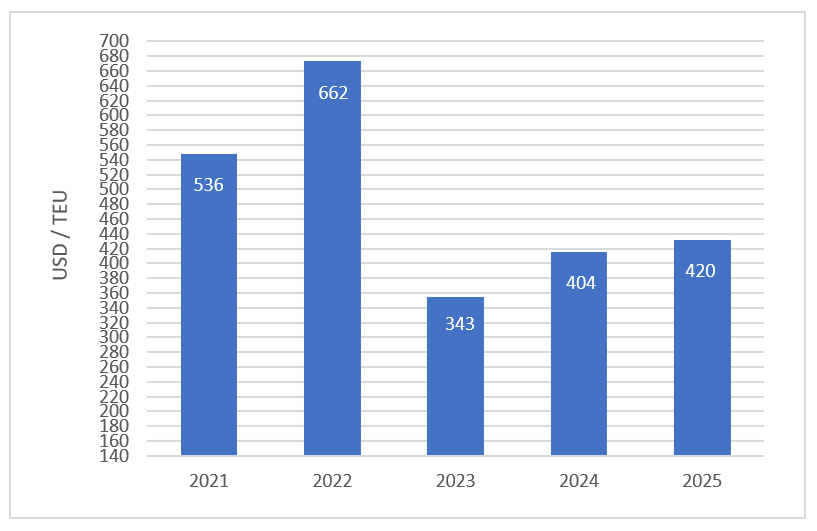
The average freight rate in 2025 was USD 420 per TEU when compared with USD 404 per TEU in 2024.
Operating Results & Financial Condition
Operating Results & Profitability
US$ per TEU | Year 2021 | Year 2022 | Year 2023 | Year 2024 | Year 2025 |
Average Freight income | 536 | 662 | 343 | 404 | 420 |
Average Cost of freight and operations | 271 | 337 | 298 | 289 | 303 |
Gross Margin | 49% | 49% | 13% | 28% | 28% |
In 2025 the freight decreased from USD 415 per TEU in the first quarter to USD 406 in the second quarter before increasing to USD 440 in the third quarter and decreasing to USD 421 per TEU in the fourth quarter.
US$ per TEU | 1Q25 | 2Q25 | 3Q25 | 4Q25 | Year 2025 |
Average Freight income | 415 | 406 | 440 | 421 | 420 |
Average Cost of freight and operations | 302 | 299 | 308 | 303 | 303 |
Gross Margin | 27% | 26% | 30% | 28% | 28% |
Cost of freight and operations increased by 6% from Baht 25.10 billion in 2024 to Baht 26.60 billion in 2025, mainly due to higher external time charter cost and increase in lifting in 2025.
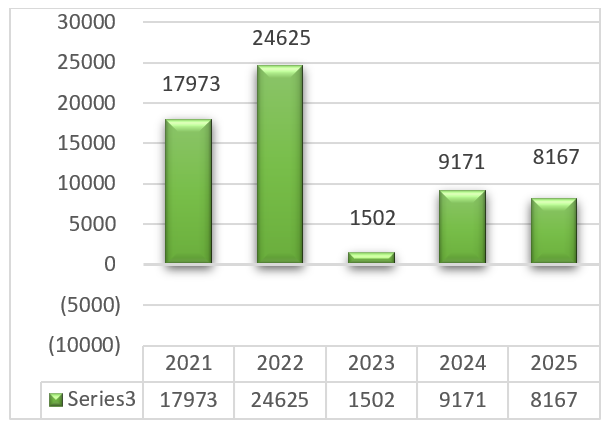
Net Profit (Baht)
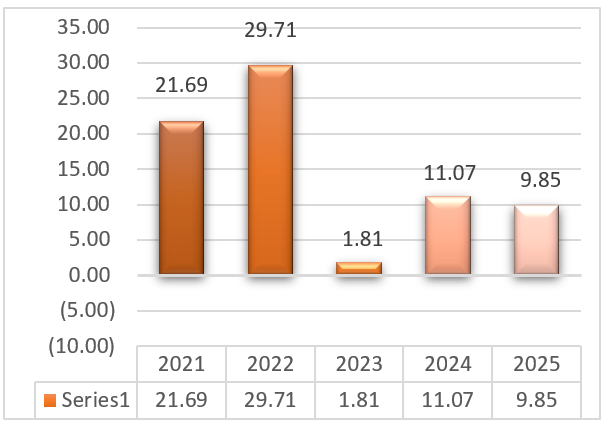
ESP (Baht)
For the full year of 2025, the Group recorded a net profit of Baht 8,167 million attributable to equity holders of the Company, compared to a net profit attributable to equity holders of the Company of Baht 9,171 million in 2024.
Profit per share for 2025 was Baht 9.854, compared to profit per share of Baht 11.066 in 2024.
Liquidity & Capital Adequacy
Capital Structure
As at end 2025, total liabilities were Baht 22.2 billion versus Baht 19.3 billion in 2024. Shareholders’ equity increased 4.54% from Baht 51.0 billion in 2024 to Baht 53.3 billion in 2025.
Total debt to shareholders’ equity increased from 0.38 to 1 in 2024 to 0.42 to 1 in 2025.
Asset Management Capability
Total assets increased by 7% to Baht 75.6 billion. Total shareholders’ equity increased by 5% to Baht 53.3 billion. Cash flow from operations was positive at Baht 11,487 million in comparison to the positive of Baht 11,760 million, the year before. As at 31 December 2025, the Group held cash and cash equivalents amounted to Baht 6.9 billion, and decrease from Baht 10.4 billion in 2024.
The 2025 EBITDA was Baht 13,607.9 million, compared to EBITDA of Baht 13,675.9 million in 2024.
Computation of EBITDA | 2025 | 2024 |
Profit / (loss) before taxation | 8,189.1 | 9,403.3 |
Add: Impairment loss of assets / Provision for loss under onerous contracts | - | - |
Add: Provision for dispute | 109.4 | 450.2 |
Less: Reversal of impairment loss of assets/ provision for loss under onerous contracts | - | (846.8) |
Less: Unrealised Gain / (Loss) from changes in fair value of derivatives | 60.5 | 6.7 |
Less: Realised loss on derivatives | ||
Add: Interest | 860.0 | 513.8 |
EBIT | 9,219.0 | 9,527.2 |
Add: Amortisation | 0.6 | 0.9 |
Add: Depreciation | 4388.3 | 4,147.8 |
EBITDA | 13,607.9 | 13,675.9 |
The Group’s cash position stood at Baht 6.9 billion as at end 2025. The year-end trade accounts receivables decreased from Baht 4.1 billion in the previous year to Baht 3.6 billion in 2025. Cash and trade account receivables accounted for Baht 10.5 billion, or 48.51% of the total current assets.
Total current assets increased from Baht 18.26 billion in 2024 to Baht 21.69 billion in 2025.
Non-current assets accounted for 71.29% of the total assets. The majority of non-current assets comprised vessels, container and equipment which amounted to Baht 39.9 billion as at end 2025.
Material & Related-Party Transactions
Details of Related Party Transaction have been disclosed in Topic 9 Internal Control and Related Party Transactions.
Debt Securities with Financial Ratio Requirements
Debt Securities with Financial Ratio Requirements Issued?
No
Factors That May Affect Financial Condition
Factors or Incidents That May Materially Affect Financial Condition
The Company’s business operations may be affected by various external factors, particularly geopolitical developments and conflicts in certain regions, which have contributed to volatility in the global economic environment and the maritime shipping industry. Such uncertainty may impact shipping demand and result in higher operating costs, especially fuel, freight and operational expenses. In addition, port congestion may lead to vessel delays, longer turnaround times, higher port-related charges, and additional operating costs. Nevertheless, the Company closely monitors these developments and has implemented appropriate cost and risk management measures to mitigate potential impacts.
In addition, fluctuations in exchange rates and interest rates, arising from global economic conditions and monetary policies across countries, may affect the Company’s financial costs and operations. However, the Company manages its financial risks prudently, supported by adequate liquidity and an appropriate capital structure. Accordingly, the potential impact of such volatility is expected to remain at a manageable level.
With respect to internal factors, the Company has implemented disciplined strategies for capacity management and asset utilization, aligning resource deployment with demand conditions. These efforts are complemented by initiatives to enhance operational efficiency, control costs, and manage risks systematically, underpinned by principles of good corporate governance, transparency, and effective oversight, in order to strengthen long-term competitiveness and business sustainability.